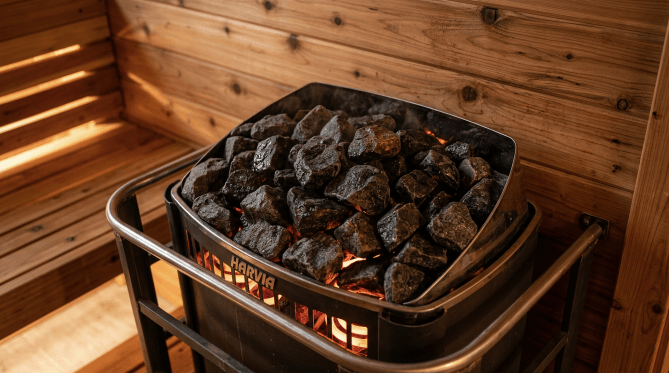
A budget sauna heater works fine for post-workout recovery, since the research behind sauna use never tested heater price, only how often and how hot people sat in one. Fifteen to twenty minutes at 170 to 190 degrees Fahrenheit, a few times a week, matches the frequency pattern in the largest studies. A correctly sized, reliably performing heater in the $400 to $800 range delivers that heat exposure exactly as well as a heater costing three times as much. The questions below cover what actually matters for using one this way.
Does the Heater’s Price Change What Recovery Benefit You Get?
Not according to the research. The Finnish cohort studies behind most sauna health claims measured session frequency and duration, not the heater’s cost or manufacturer. A heater that reliably hits and holds 170 to 190 degrees is providing the heat exposure those studies describe, whether it cost $400 or $2,000. Where heater quality actually matters for a recovery routine is reliability: a heater prone to breaking down or struggling to reach temperature disrupts the consistency that the research associates with better outcomes far more than a modest price tag does.
How Soon After Training Should You Use It?
Most people wait roughly 20 to 30 minutes after an intense workout, giving heart rate and core temperature a chance to come down somewhat before adding more heat stress on top of exercise stress. There is no single studied optimal window here, and personal tolerance varies a fair amount. Starting with a longer gap and shortening it over time as your body adjusts is a reasonable, low-risk approach for anyone new to combining training and sauna use.
What Does a Reasonable Session Actually Look Like?
Fifteen to twenty minutes at 170 to 190 degrees Fahrenheit is a common starting range for someone with some sauna experience, while a complete beginner should start shorter, closer to 8 to 10 minutes, and build up gradually across several weeks. Hydration matters more here than most people account for, since sweating during exercise and then again during a sauna session compounds fluid loss. A budget heater that reaches this temperature range consistently, without a long warm-up eating into workout time, is entirely sufficient for this kind of routine.
Should Recovery-Focused Use Change What Heater You Buy?
Mostly no, but warm-up time is worth weighing more heavily if the sauna gets used immediately after most workouts on a tight schedule. A heater sized correctly for the room, in the 4.5 to 6 kilowatt range for a small two-person cabin, typically reaches session temperature in 20 to 30 minutes, which is worth timing against your actual post-workout routine. Comparing warm-up times and kilowatt ratings across a few listed models, including options at Sweat Decks, before buying helps avoid ending up with a heater that is technically correctly sized but slower to heat than your schedule allows for.
Does Sauna Use Replace Other Recovery Basics?
No, and treating it that way is a mistake. Sleep, hydration, and basic mobility work have a stronger, more direct evidence base for recovery than heat exposure does on its own. Sauna use functions better as an addition layered on top of those basics, not a substitute for a workout routine’s actual recovery foundation. Anyone skipping sleep or hydration to fit in a sauna session is very likely making a worse trade than the session is worth.
See also: How Artificial Intelligence Is Reshaping Marketing Campaigns
Is Cold Plunge Better Paired With It, or Does It Cancel the Benefit?
Some people follow a hot sauna session with cold water immersion, but the evidence here is genuinely mixed, and it is worth being honest about that rather than presenting contrast therapy as an obvious upgrade. Cold-water immersion research on recovery is inconsistent, and some trials suggest it may blunt strength and muscle-building adaptations when used immediately after resistance training specifically. For general recovery and relaxation rather than a strength-focused training block, pairing the two is a personal preference question more than a settled research recommendation.
What Does the Actual Research Say About Frequency and Recovery?
A large Finnish cohort study published in JAMA Internal Medicine found men using a sauna four to seven times weekly had lower rates of fatal cardiovascular events than men using one once weekly, an association that held after adjusting for other factors. A follow-up study in Annals of Medicine found the combination of higher cardiorespiratory fitness and frequent sauna use was associated with the lowest mortality risk of any group studied, which is relevant for anyone using a sauna specifically around workouts. A separate 2018 study in Heart and Vessels measured short-term changes in cardiovascular markers following individual sauna sessions in regular users. None of this is proof that sauna use accelerates muscle recovery specifically, but it supports frequent, consistent use as the pattern associated with the best-studied outcomes.
Building the Habit Without Overdoing It
Starting a new sauna-after-training habit at the longer end of session length is a common mistake, since heat tolerance builds gradually the same way cardiovascular fitness does. A reasonable ramp is two short sessions a week for the first couple of weeks, roughly 8 to 10 minutes each, before working up to the 15 to 20 minute range the research pattern favors. Pushing straight to daily 20-minute sessions in week one is more likely to cause a dizzy or uncomfortable first experience that puts someone off the habit entirely than it is to accelerate any benefit, since the cohort research reflects years of accumulated regular use, not an aggressive first month.
Signs You Are Overdoing the Combination
Lightheadedness on standing, unusual fatigue the following day, or a resting heart rate that stays elevated longer than normal after a session are reasonable signals to scale back frequency or session length rather than push through. This matters more for anyone combining sauna with already-demanding training blocks, since stacking two forms of physiological stress without enough recovery between them can work against the goal rather than support it. None of this is a reason to avoid the combination, but pairing intensity in training with intensity in sauna use on the same day is worth approaching gradually rather than assuming more is automatically better.
Frequently Asked Questions
Do you need an expensive sauna heater to use it for workout recovery? No, a correctly sized budget heater reaching 170 to 190 degrees provides the same heat exposure studied in the research.
How soon after a workout should you use a sauna heater? Most people wait 20 to 30 minutes, though there is no single studied optimal window.
How long and how hot should a post-workout sauna session be? A common range is 15 to 20 minutes at 170 to 190 degrees, shorter for beginners.
Can regular sauna use replace other recovery methods like stretching or sleep? No, it works best as an addition to those basics, not a substitute.
Is it safe to sauna after every single workout? For most healthy adults, yes, though anyone with a cardiovascular condition should check with a doctor first.
References
- Association between sauna bathing and fatal cardiovascular and all-cause mortality events, JAMA Internal Medicine, 2015
- Joint associations of sauna bathing and cardiorespiratory fitness on cardiovascular and all-cause mortality risk: a long-term prospective cohort study, Annals of Medicine, 2018
- Short-term effects of Finnish sauna bathing on blood-based markers of cardiovascular function in non-naive sauna users, Heart and Vessels, 2018
By Danielle Prewitt